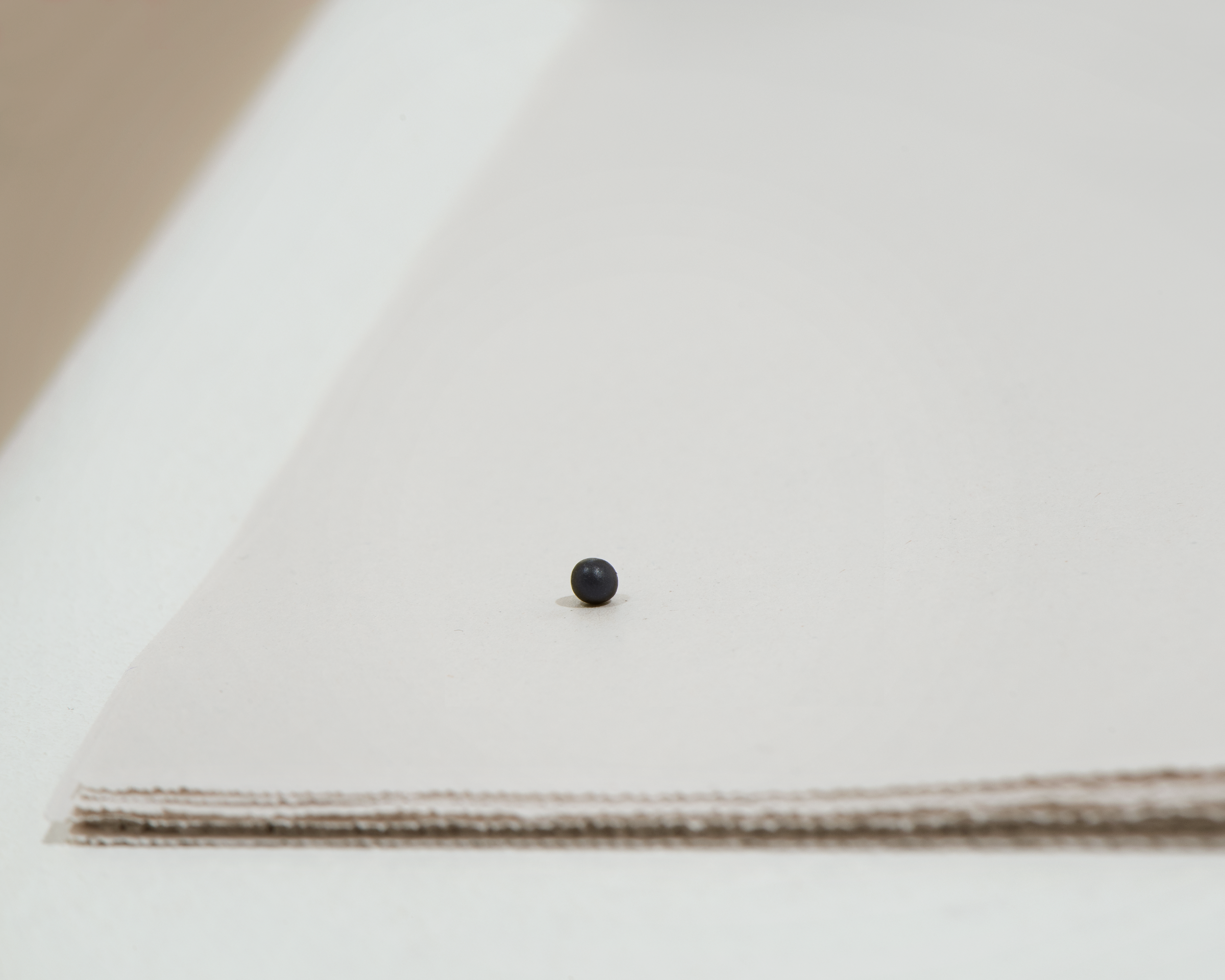
Extracted Memory Series
A chemical reaction removes the ink from printed matter, reshaping this sedimented memory.

Le Monde [2015]
An edition of French newspaper Le Monde has been rendered blank by a chemical process, separating the printed ink from the paper’s fibers; and, the extracted ink turned into a miniature sphere.
L’Univers [2017]
In 1870 French scientist Félix Pouchet publishes L’Univers, an epic compendium of the origin of life and everything living. The scientist, who around that time was one of the most celebrated biologists of Europe, fell into oblivion after Pasteur demonstrated that Pouchet was wrong on the very core of his research: he had supported the spontaneous generation of life.
For this piece, Santillán has taken this prominent book from the 19th century, and has “extracted life” from it by chemically removing its printed ink and using it to create spherical miniatures orbiting around the book, as if the exploration for life would perhaps continue in other planets and galaxies.
Lost Star [2013]
An early edition of Alexander von Humboldt’s scientific magnum opus. Cosmos, has been treated with a chemical process that separates the printed ink from the paper’s fibers, removing all words and images from the original publication. The entirety of the book’s contents, expressed through its ink, is turned into a tiny sphere displayed next to the then blank book.
Memorial [2008]
Pages of The New York Times were subjected to a custom chemical process that separated the printed ink from the paper. Once extracted, the ink was consolidated and shaped into a small, fragile creature displayed alongside the altered newspaper.
The work transforms printed information into a physical remnant, exploring the materiality of memory and the ways in which knowledge can be displaced, condensed, and reimagined through scientific intervention. The project marked the first use of this technique in Oscar Santillán’s artistic practice.